3 Common ROAS Pitfalls and How to Avoid Them
ROAS is useful, but ignoring costs, lifetime value, and margin differences can lead to misleading results.
AOV is valuable for understanding transaction patterns, but focusing on it in isolation can lead to short-sighted strategies and customer experience issues.
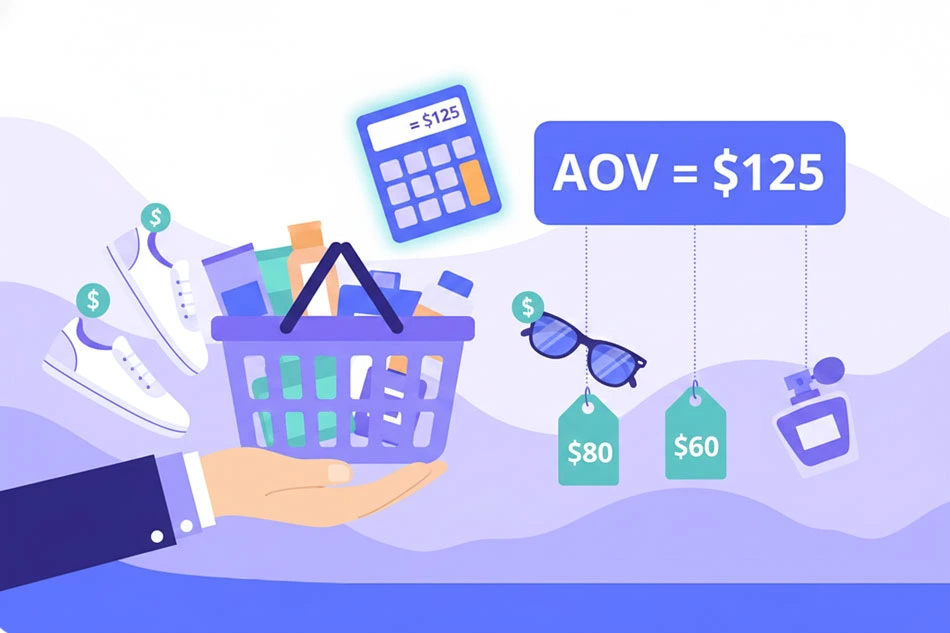
Average Order Value (AOV) is a fundamental metric for understanding customer purchasing behavior and revenue potential — but relying on it too heavily can create blind spots in your strategy. Misusing AOV can damage customer relationships, skew your marketing decisions, and ultimately hurt profitability.
Here are three of the most common pitfalls businesses face when optimizing for AOV, and how to avoid them.
Treating all customers the same based on a single AOV number can lead to one-size-fits-all strategies that alienate valuable segments. Not all customers have the same purchasing power, motivations, or buying patterns:
Pushing tactics that increase AOV (like free shipping minimums or product bundles) uniformly across all segments can frustrate budget-conscious customers and reduce conversion rates, even if it lifts AOV among those who do purchase.
Segment your AOV data by customer type, traffic source, and purchase history. Analyze which segments naturally have higher AOV and which are more price-sensitive. Tailor your strategies accordingly — offer premium bundles to high-value segments while providing single-item options for price-conscious shoppers. This targeted approach increases AOV where it makes sense without sacrificing conversion rates across your entire customer base.
Aggressive tactics to boost AOV can backfire if they create friction or feel manipulative. Customers who feel pressured by heavy-handed upsells, forced bundles, or unreasonable free shipping thresholds may abandon their cart entirely — or worse, develop negative associations with your brand that hurt long-term retention.
Common experience-damaging tactics include:
Balance AOV optimization with genuine value creation. Use tactics like "frequently bought together" recommendations that feel helpful rather than pushy, educational content that demonstrates why premium options deliver better results, and transparent shipping thresholds that align with typical purchase patterns. Monitor cart abandonment rates and customer feedback to ensure your AOV strategies aren't creating friction. A slightly lower AOV with happy, returning customers is far more valuable than maximizing one-time transaction values at the expense of retention.
AOV measures transaction size, but it exists within a broader ecosystem of metrics that determine actual business performance. Optimizing solely for AOV without considering its impact on conversion rate, customer acquisition cost (CAC), and customer lifetime value (CLV) can lead to counterproductive strategies:
A business with $75 AOV and 5% conversion rate generates far more revenue than one with $100 AOV and 2% conversion rate, even though the latter has "better" AOV.
Track AOV alongside conversion rate, total revenue, gross margin, CAC, and CLV to understand the full picture. Calculate your "effective revenue per visitor" (AOV × conversion rate) to see whether AOV optimization is actually improving business outcomes. Test AOV-focused strategies in controlled experiments and measure their impact on overall revenue and profitability, not just average transaction size. Remember that the goal isn't the highest possible AOV — it's the most profitable balance between transaction value, conversion efficiency, and customer satisfaction.
AOV is a valuable indicator of customer purchasing patterns and revenue potential, but it should never be optimized in isolation. By segmenting your approach for different customer types, prioritizing experience alongside transaction value, and analyzing AOV within the context of broader business metrics, you can avoid common pitfalls and build sustainable, profitable growth strategies.
Return on Ad Spend (ROAS) is a powerful metric for evaluating the efficiency of your advertising campaigns — but it’s not without its limitations. Misinterpreting or over-relying on ROAS can lead to poor strategic decisions, wasted budget, and missed growth opportunities.
Here are three of the most common pitfalls businesses face when using ROAS, and how to avoid them.
A high ROAS can look impressive on the surface, but it doesn’t tell the whole story. ROAS measures revenue generated against ad spend alone — it doesn’t factor in other costs that eat into profit, such as:
If these expenses are significant, your true profitability could be far lower than your ROAS suggests.
Always review ROAS alongside broader financial metrics such as gross profit, net margin, and operating costs. This gives you a more accurate picture of campaign performance and prevents overestimating success.
Many marketers focus on immediate ROAS results without considering the long-term value of the customers acquired. This is especially risky in subscription-based or repeat-purchase businesses, where the bulk of profit often comes months or years after the first sale.
Incorporate Customer Lifetime Value (CLV) into your analysis. A campaign with a low initial ROAS might still be highly profitable if it brings in customers who purchase repeatedly over time. Combining ROAS and CLV metrics helps you make decisions that drive sustainable growth, not just short-term wins.
If your business sells products with different profit margins, a single ROAS target for all campaigns can be misleading. A campaign advertising a high-margin product may be profitable with a lower ROAS, while a low-margin product might require a much higher ROAS to break even.
Factor in product margins when setting ROAS targets. Use metrics like gross profit or contribution margin per sale to assess whether campaigns are truly profitable. This ensures that your ad strategy supports overall profitability rather than chasing arbitrary ratios.
ROAS is an essential metric for evaluating advertising performance, but it should never be viewed in isolation. By accounting for additional costs, considering customer lifetime value, and tailoring targets to product margins, you can avoid the most common pitfalls and make smarter, more profitable marketing decisions.