
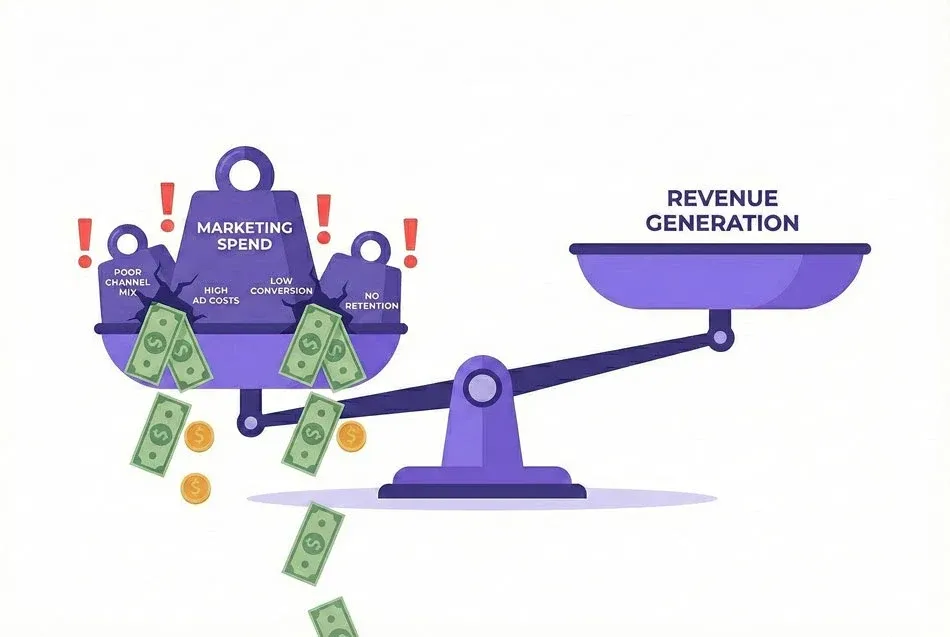
Misalignment with Business Goals
Focusing solely on improving MER can lead to cutting marketing spend, which potentially harms long-term growth. A business reducing spend from $50,000 to $30,000 might see MER improve from 4 to 5, but if revenue drops from $200,000 to $150,000, the "improved" efficiency actually destroyed $50,000 in revenue.
How to avoid this pitfall:
Balance MER with growth objectives. Use MER alongside Customer Acquisition Cost (CAC) and Lifetime Value (LTV) to ensure sustainable growth. A healthy business might accept temporary MER decline from 5 to 4 if it enables scaling from $200,000 to $400,000 in monthly revenue.
Recognize that strategic investment in growth often means accepting lower MER temporarily. Entering new markets, testing new channels, or building brand awareness typically shows lower initial efficiency but creates long-term value that MER alone doesn't capture.
Set MER targets in context of revenue goals. Instead of "maximize MER," aim for "maintain MER above 4 while growing revenue 20% month-over-month." This frames efficiency as a constraint rather than the primary objective.
Overlooking Discounts and Promotions
Heavy reliance on discounts can inflate revenue figures, making MER appear healthy while profit margins suffer. A business with MER of 6 looks efficient, but if they're achieving that through 30% discounts that destroy margin, the actual profitability is terrible.
How to maintain accurate profitability assessment:
Monitor contribution margin alongside MER to get a true picture of profitability. Contribution margin accounts for product costs and discounts, revealing whether revenue efficiency translates to profit efficiency.
Calculate promotion-adjusted MER by treating discount amounts as additional marketing costs. If you spend $20,000 on ads and offer $8,000 in promotional discounts, your true marketing investment is $28,000, not $20,000.
Assess how discounts affect both immediate MER and long-term customer value. Acquiring discount-seeking customers at strong MER means nothing if they never return at full price. Track cohort retention and repeat purchase rates by acquisition method.
Track promotional vs. non-promotional revenue separately. Understanding your baseline MER without promotions reveals true marketing efficiency and helps avoid the trap of addiction to discounting for maintaining revenue levels.
Ignoring Attribution Complexity
MER's simplicity - total revenue divided by total spend - hides the complexity of how customers actually purchase. Multi-touch journeys, offline influences, and organic factors all contribute to revenue but don't appear in marketing spend calculations.
How to account for attribution nuance:
Recognize that MER includes revenue from all sources, not just marketing-driven sales. Organic search, direct traffic, word-of-mouth, and brand equity all contribute to the numerator without appearing in the denominator, inflating apparent marketing efficiency.
Compare MER to channel-specific ROAS to understand which activities genuinely drive efficiency. If overall MER is 6 but your paid channels show ROAS of 3, the gap reveals significant non-paid revenue contribution that might disappear if you cut marketing spend chasing higher MER.
Use incrementality testing to understand how much revenue actually depends on marketing. Periodically pause or reduce spend in test markets to measure the true impact of marketing versus baseline sales that would occur anyway.
Focusing Only on Top-Line Revenue
MER measures revenue efficiency but says nothing about profit efficiency. High MER with low margins or high operational costs can still result in unprofitable growth.
How to connect MER to actual profitability:
Calculate your breakeven MER based on gross margin. If gross margin is 40%, breakeven MER is 2.5 (1 / 0.40). Any MER below this level loses money regardless of revenue volume.
Set profit-oriented MER targets that ensure desired profitability levels. If you need 15% net profit margin and gross margin is 45%, account for 30% operational costs and target MER of 3.3+ (1 / 0.45 / 0.70) to hit profit goals.
Track both MER and profit margin together. MER can improve while profit margin deteriorates if you're shifting to lower-margin products, increasing discounts, or seeing rising fulfillment costs. Monitor both metrics to ensure efficiency gains translate to bottom-line improvement.
Short-Term Optimization at Long-Term Expense
Optimizing for immediate MER can sacrifice investments in brand building, content, and organic channels that deliver compounding returns over time but show poor short-term metrics.
How to balance short and long-term efficiency:
Separate brand-building and performance marketing budgets with different MER expectations. Brand awareness campaigns might show MER of 2-3 initially but create lasting equity that improves efficiency of all future marketing. Performance marketing should hit higher MER targets (4-6+) immediately.
Track cohort performance over extended periods. Customers acquired when MER was temporarily lower due to brand investment may show superior lifetime value that justifies the initial efficiency sacrifice.
Invest in owned channels (email lists, social followers, content) that reduce future dependence on paid marketing. These investments might depress current MER but create sustainable, cost-effective revenue channels that dramatically improve long-term blended MER.
Putting It Into Practice
Effective MER usage requires understanding its limitations and using it as part of a comprehensive metrics framework rather than a standalone success measure. Set MER targets that support profitability while enabling growth, monitor it alongside margin and revenue metrics, and avoid the trap of optimizing efficiency at the expense of business objectives.