
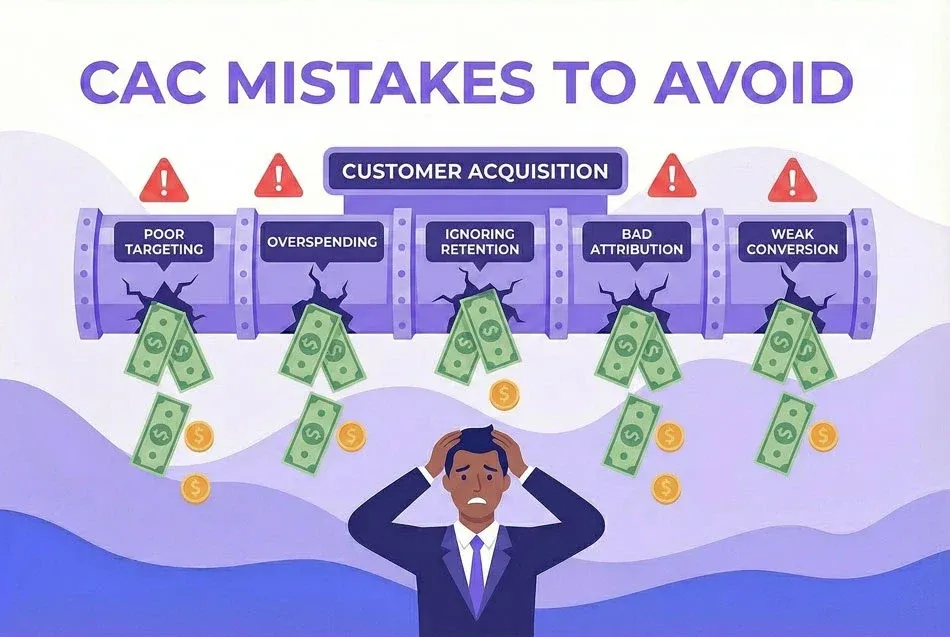
Common CAC Calculation Mistakes
Including All Relevant Costs
Many businesses underestimate CAC by only counting direct ad spend. True CAC includes employee salaries, marketing software, agency fees, content creation, promotional discounts, and overhead allocation.
Create a comprehensive cost tracking system that captures all acquisition expenses monthly. Most businesses discover their true CAC is 40-60% higher once all costs are properly included. If your marketing team splits time between acquisition and retention, allocate costs proportionally.
Using Proper Attribution
Last-click attribution ignores the multiple touchpoints before conversion. Customers interact with several ads across multiple sessions before purchasing, and last-click attribution undervalues awareness and consideration-stage marketing.
Implement multi-touch attribution models (linear, time-decay, or position-based) to understand true channel contribution. Track assisted conversions - a channel with poor last-click CAC might excel at assisting conversions that other channels close. Use view-through conversion tracking for display and video campaigns, and validate attribution models with holdout testing.
Balancing Cost and Quality
Lowering CAC without considering customer quality is counterproductive. Customers acquired at $20 CAC who never return underperform customers acquired at $80 CAC who become loyal repeat purchasers.
Track quality metrics alongside CAC: first order AOV, 90-day repeat rate, return rates, and LTV by channel. Set CAC targets by segment based on expected value, not uniform targets. Monitor how promotional intensity affects customer quality - heavy discounting may reduce immediate CAC but attracts low-quality customers with poor retention.
Optimization Tactics
Improve Targeting
Refined audience targeting reduces wasted spend on unlikely converters. Build lookalike audiences based on highest-LTV customers, not just any converters. Use negative targeting to exclude bargain hunters, serial returners, or incompatible demographics. Implement geographic targeting based on performance data - concentrate spending where conversion rates and LTV are strongest.
Leverage first-party data for precision targeting. Email lists, website visitors, and customer databases provide higher-intent audiences than cold prospecting. Test creative variations by segment - generic messaging fails to resonate and drives up CAC.
Enhance Conversion Rates
Every percentage point improvement in conversion rate proportionally reduces CAC. Optimize landing pages to match ad messaging, ensure fast load times, and include clear calls to action. Simplify checkout by reducing form fields and offering multiple payment options.
Implement trust signals: security badges, reviews, return policies, and testimonials reduce purchase anxiety. Use A/B testing systematically - small wins compound. Ensure mobile experience matches desktop, as mobile often represents 60%+ of traffic.
Leverage Retargeting
Retargeting warm audiences costs far less than cold prospecting. Segment by engagement level: product viewers, cart abandoners, and checkout abandoners require different messaging. Use dynamic ads showcasing products users viewed.
Implement frequency capping to avoid ad fatigue - showing the same ad 20 times wastes budget. Create sequential retargeting that addresses objections over time: remind, build trust, provide social proof, offer incentive.
Use Cost-Effective Channels
Email marketing nurtures leads at near-zero marginal cost. Invest in SEO for organic traffic that converts without per-click costs. Build community and organic social presence for word-of-mouth referrals. Create valuable content (guides, tools, calculators) that attracts high-intent traffic.
Negotiate Better Rates
Request volume discounts once you reach spending thresholds. Consider bulk ad purchases for cost advantages. Review vendor contracts regularly - market rates change. Explore alternative platforms - competitive pressure motivates better pricing.
Implementation Approach
Sustainable CAC reduction requires systematic execution. Establish baseline CAC and track weekly. Prioritize initiatives by impact and effort - quick wins build momentum while major initiatives deliver step-change improvements. Test changes incrementally through controlled experiments rather than wholesale shifts. Document learnings and apply insights across channels.
Focus on the fundamentals: include all costs in calculations, use proper attribution, improve targeting precision, optimize conversion rates, and leverage retargeting. These tactics compound over time, systematically reducing CAC while maintaining or improving customer quality.