
Traffic Channels
Consolidate sources and campaign variants into consistent acquisition channels.
Updated 9 August 2026Why channel classification matters
Source names arrive from advertising platforms, email tools, referrals and campaign links in many different formats. Traffic Channels convert those variants into a stable acquisition taxonomy, allowing cost, visits, conversions and revenue to be compared on the same terms.
Incendium evaluates Channel rules in priority order and assigns each session to the first match. This makes Channels mutually exclusive: one session is counted once, in the most relevant Channel, instead of appearing in several competing totals.
Platforms can keep the labels and conversion models they need for optimisation, while Incendium applies one transparent rule set across them. That creates a more consistent basis for human decisions and downstream analysis.
Review the standard Channels
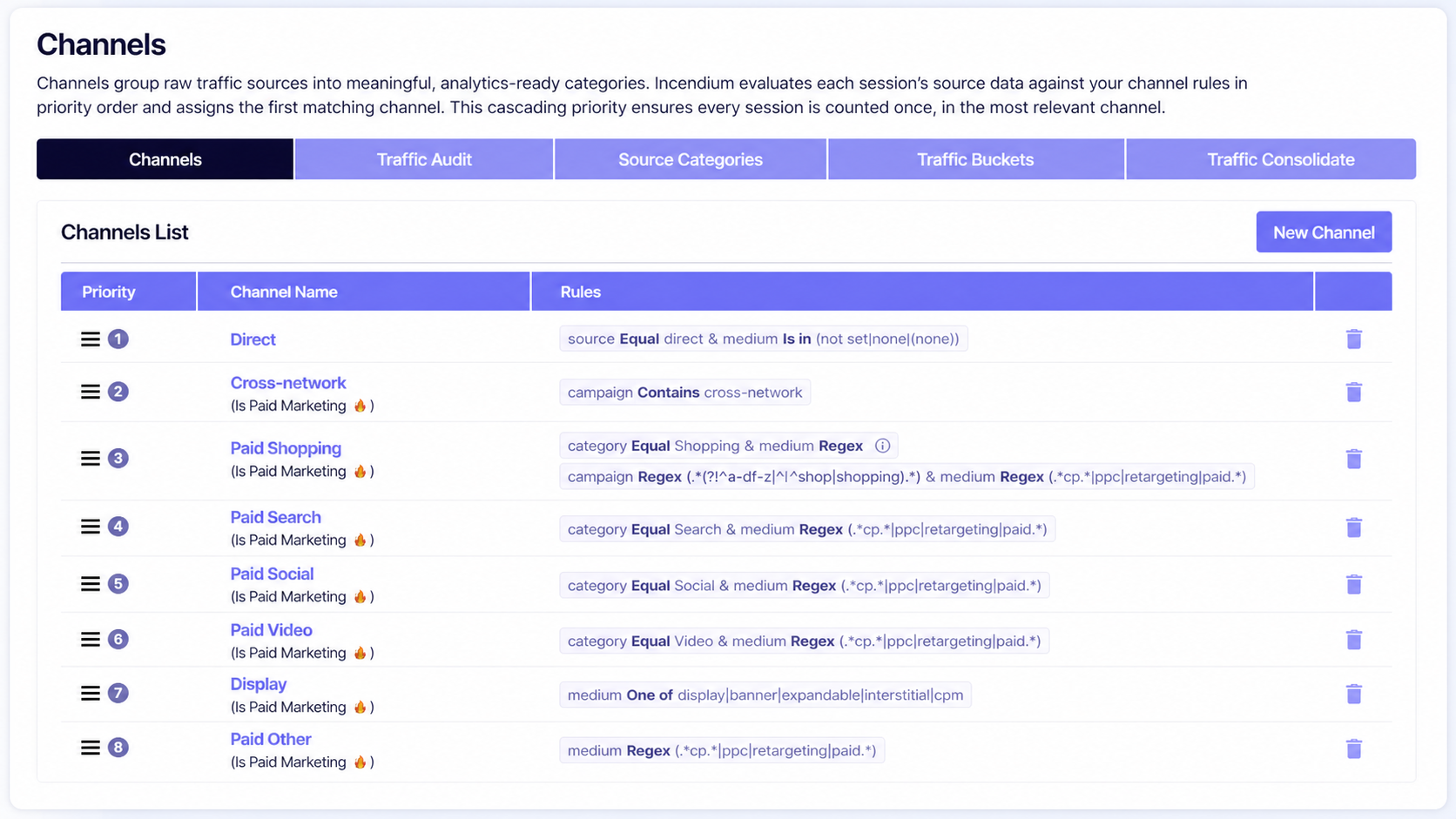
Ecommerce setup includes a practical starting taxonomy. Review it before adding new Channels: a new source variant may only require an existing rule or Source Category to be extended.
Create or edit a Channel
Choose a clear outcome
Open Setup & Measurement → Traffic Channels. Decide what the Channel represents and whether it is paid marketing.
Build rules from reliable fields
Use source, medium, campaign or Source Category with operators such as Equal, Contains, One of, Is in or Regex. Combine conditions with AND/OR only when the intended logic is clear.
Set its priority
Place specific Channels above broader catch-all rules. If a session matches more than one, the earliest matching rule determines its Channel.
Validate with real sessions
Use Traffic Audit and the unmatched-source diagnostics to confirm recent traffic is classified as intended.
Maintain the taxonomy
- Review unmatched sources and unclassified visits regularly.
- Test changes against a recent period before reordering priorities.
- Keep specific paid rules above broad referral or catch-all rules.
- Use Source Categories for provider families that recur across rules.
- Consolidate spelling, case and tool-generated variants rather than creating duplicate Channels.
- Record material rule changes so reporting shifts can be distinguished from marketing shifts.
A well-maintained taxonomy should explain nearly all meaningful traffic while remaining short enough to audit. The goal is not the largest rule set; it is a stable, understandable view of acquisition.